
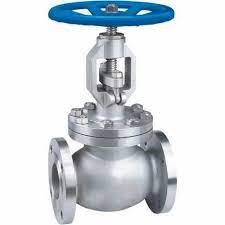
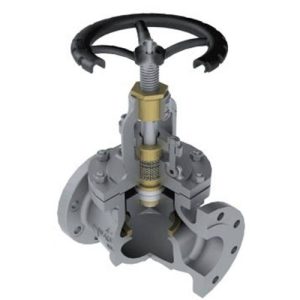
Globe valves are one of the most widely used industrial valves, primarily employed for flow regulation. Their design features a disk and seat alignment that enables precise flow control by altering the flow direction within the valve. In globe valves, the blocking component (disk) moves perpendicular to the valve seat surface, which contributes to effective control but also results in a pressure drop across the valve. This unique configuration makes globe valves ideal for applications requiring accurate flow adjustment.
Material:
Industrial globe valves are available in various materials to suit different fluid types and operating environments. Common materials include steel, cast iron, plastic (PE, PP, UPVC), brass, bronze, and specialized alloys.
Most globe valve bodies are constructed from carbon steel, which performs reliably for non-corrosive fluids up to temperatures of 425°C in continuous service.
Stainless steel is also widely used due to its excellent corrosion resistance and capability to withstand temperatures as high as 800°C, making it suitable for high-temperature applications.
Types of Globe Valves
- ‘ Y ‘ TYPE
- ANGLE 90°globe VALVES BELLOW SEAL ‘ Y ‘ TYPE
- PRESSURE SEAL ‘ Y ‘ TYPE
- BOLTED BONNET
- CRYOGENIC
- BELLOW SEAL
- PRESSURE SEAL
Applications
- Oil and Gas Industry:
- Petrochemical and chemical industries
- Mining Industry
- Steel Industry
- Pharmaceutical and Food Industries
- Marine Industry
- Nuclear and Power Plants
Pressure - Class:
- Globe Valve class#150
- Globe Valve class#300
- Globe Valve class#600
- Globe Valve class#900
- Globe Valve class#1500
- Globe Valve class#2500
Reviews
There are no reviews yet.