
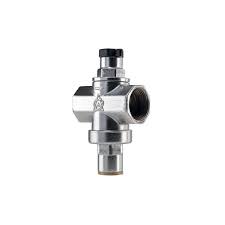
Pressure reducing valves are devices used in industries to prevent excessive pressure and protect piping systems. They are also used to reduce or break the pressure of fluids. Whenever the system pressure reaches a pre-set value, the valve opens and adjusts the pressure to reduce it to a permissible and desirable level. Once the pressure is at the right level, the valve closes. In a hydraulic circuit, hydraulic pumps generate pressure. Pressure reducing valves control and adjust the pressure generated by these pumps. The main function of these valves is to maintain a constant output pressure.
 Types of Pressure Reducing Valves:
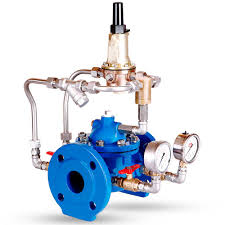 Types of Pressure Reducing Valves:
Direct Acting Pressure Reducing Valve:
These are the simplest type of pressure reducing valves. In this type, the output steam pressure (reduced pressure) applies force to the underside of the diaphragm, and in response, the spring applies a downward force. The resultant force, combined with the upward force from the incoming flow to the valve, determines the exact position of the main valve and, consequently, the pressure reduction percentage.
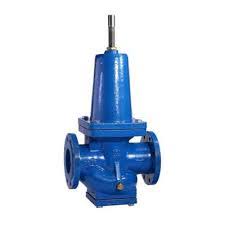
Pilot Operated Pressure Reducing Valve:
Pilot operated pressure reducing valves are used when precise control of pressure or steam flow is essential. The main structure of these valves includes an adjusting spring, a helper diaphragm, a guide valve, a main valve, and a main diaphragm. Pilot operated valves have advantages over direct acting pressure reducing valves. To change the main valve position, only a small amount of steam flow is required, making small changes in the input pressure lead to significant changes in the main flow, indicating the high sensitivity
Advantages:
- No need for external force
- Usable for liquids, gases, and steam
- Simple design and low cost
- Easy maintenance
- Very low external leakage
Disadvantages:
- The control environment must be kept very clean for proper operation.
- When pressure drop in the valve is minimal, regulators lose their ability to control because the environment cannot provide sufficient operational power.
- Regulators cannot adapt to noise or cavitation issues.
Reviews
There are no reviews yet.