
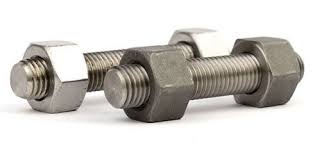
A Stud Bolt consists of a fully threaded steel rod and two hexagonal steel nuts. This product is most commonly used in the oil, gas, and petrochemical industries, primarily for fastening flanges. It is inserted into flange holes and fastened with hex nuts on both sides. The quantity, length, and diameter of the stud bolts required for flange fastening depend on the type, diameter, and grade of the flange. Stud bolts are manufactured through a complex thermal process to ensure maximum hardness and maintain their resistance in both cold and hot environments.
 Types of Stud Bolt:
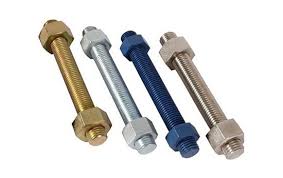 Types of Stud Bolt:
- Full thread: The entire length of the rod is threaded.
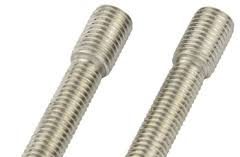
- Partial thread: Only the two ends of the rod are threaded, and the middle section is smooth.
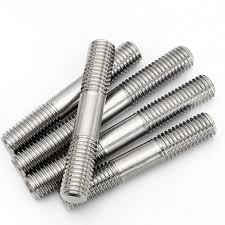
- Double end: Both ends have threads of different lengths.
- Tap end: One end has an external thread, and the other has an internal thread.
Difference between Stud Bolt and Bolt:
A Stud Bolt is a metal rod or shaft with threads on both ends and requires two heavy hex nuts for fastening on each side. A bolt, on the other hand, is a fastener that has a "recessed" nut on one side and only requires one nut for fastening.
Advantages of Stud Bolt:
- Uniform force distribution
- Adjustable
- High load-bearing capacity
- Long lifespan
- High tensile strength
- High flexibility
Disadvantages of Stud Bolt:
- Higher cost
- Longer installation time
- Requires more space
- Complexity in production
Applications
- Oil and Gas Industry:
- Oil and Gas Industry
- Manufacturing of pressure vessels
- Installing pumps and compressors
- Fastening metal structures
- Installing precast concrete beams
- Connecting bridge components and civil engineering structures
- Installing heavy machinery in factories
- Manufacturing and repairing ships
- Installing equipment on oil rigs
- Constructing docks and ports
- Fastening components in aircraft and spacecraft construction
- Petrochemical industries
- Power plants

Reviews
There are no reviews yet.